
A favourable monsoon and government support to the rural economy are among the reasons that agrochemical companies, including makers of pesticides and fertilisers, have done well.

June indicates a change in trend from previous quarters in terms of how much companies are spending on employees. The worst hit sectors included steel, air transport service and automobile firms.
The combined profit before tax of 748 companies, which have declared their results for Q1FY21, is down 46 per cent YoY. Their net sales went down by a quarter as the Covid-19 lockdown led to a sharp fall in economic activity.

The current valuation is 38 per cent higher than the 10-year average of 22x and over 50 per cent higher than the 20-year average of around 20x.
Many weekly indicators turn positive as economy prepares for Unlock 3.0.

The Indian Railways is replacing its outdated signalling system with the latest automated train protection technologies - European Train Control System and Train Collision Avoidance System.

Oil marketing companies IOC, BPCL and HPCL have invited expressions of interest from start-ups that wish to be enrolled as fuel entrepreneurs for doorstep delivery of high-speed diesel through mobile petrol pumps.
Mumbai traffic, mobile internet speeds, and grocery and pharmacy visits are all showing lower numbers for the latest week.
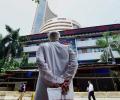
In three of the past four years, 10-year returns have been 10 per cent or lower, making equity unattractive, compared to other asset classes.

The combined weight of IT companies in the benchmark Nifty 50 index is now at a five-year high of 15 per cent as these companies continue to outperform the broader market.

Equity investors should thank cash-rich biggies such as TCS, ITC, HUL, Nestl, and Bajaj Auto for this.
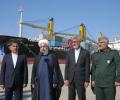
Iran's growing proximity to China may have also played a part.

Under the plan, there will be 151 private trains covering 109 routes which may entail investments worth Rs 30,000 crore.

Lenders had filed 1,251 cases to recover Rs 24,765.5 crore. Wilful defaulters are the entities that do not pay back money despite the ability to do so. Defaulters above Rs 1 crore were considered for this exercise.
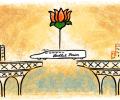
Apart from land acquisition, another major cause for concern before the project is cost escalation owing to a fall in the rupee against the Japanese yen.
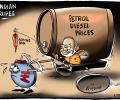
Despite a massive decline in crude oil prices since 2012 -- Modi has been prime minister in six of these eight years -- petrol in Delhi has become 10 per cent costlier and diesel 97 per cent, as of July 2.

Together, the top 10 business groups reported a pre-tax loss of Rs 19,342 crore during the January-March 2020 quarter, as against a profit before tax of around Rs 48,500 crore in the year-ago period and Rs 39,600 crore during the December quarter. While Vedanta was the worst hit. others included Aditya Birla, Bharti, Adani, Mahindra, and Tata.
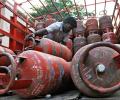
Given that the target was to reach 80.34 million families under PMUY - within three months starting April 1 - the government should have distributed at least 241.02 million cylinders by the end of June. It actually ended up distributing only 119.7 million cylinders.
These mega projects, worth about Rs 1 trillion, would boost the economy, ensure smooth supply of petroleum products across the nation and also provide the much-needed relief to people looking to get back to work after the lockdown.
 © 2026 Rediff.com - Investor Information - Advertise with us - Disclaimer - Privacy Policy - Sitemap - Feedback - About us - Terms of use - Grievances